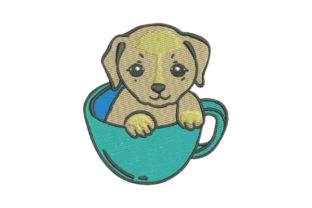
Puppy in Cup: A Designer’s Real-World Review
First Impressions: Sweet, Simple, and Surprisingly Versatile
When I opened Puppy in Cup on Creative Fabrica, I wasn’t expecting much beyond a charming novelty—but what stood out immediately was its thoughtful balance of simplicity and character. This isn’t just another cartoon puppy; it’s a compact, expressive machine embroidery design with gentle curves, soft facial features, and that unmistakable “cup-hugging” posture that reads as cozy, playful, and deeply kid-friendly. The line work feels intentional—not overly fussy, not too minimal—and the implied texture (especially around the ears and muzzle) suggests satin stitch and fill stitch transitions that hold up well without excessive density. As an embroidery designer who regularly selects designs for commercial use, I appreciated how quickly Puppy in Cup communicated warmth and approachability—ideal for handmade products where emotional resonance matters as much as technical execution.
Fits Naturally Into Real Projects—Without Forcing It
Puppy in Cup doesn’t demand center-stage attention. Instead, it slots gracefully into everyday items: a small embroidered patch on a denim tote bag, a subtle chest placement on a baby onesie, a playful accent on a kitchen towel hem, or even a stitched-on applique for a nursery pillow cover. I tested it across several substrates—cotton twill for aprons, medium-weight terry for towels, and brushed poly-cotton for toddler sweatshirts—and each time, the design retained clarity and charm. Its compact footprint makes it especially effective for smaller hoop sizes (4x4" and 5x7"), which is critical when producing custom apparel or Etsy-ready bundles at scale. Unlike some dog-themed embroidery files that rely on intricate details or fine lettering, Puppy in Cup avoids tiny elements that fray or blur on textured fabric—no micro-eyes, no fragile whiskers, no dense underlay traps. That means fewer re-stitches, less thread breakage, and more consistent results across varied machines and skill levels.
Performance on Tricky Fabrics & Use Cases
Stretchy knits? With proper cutaway stabilizer and a light tear-away topper, Puppy in Cup held its shape beautifully on a lightweight cotton-blend sweatshirt—no puckering, no distortion. Dark fabrics? The design’s generous satin stitch outlines provide natural contrast, and switching to matte or slightly heathered thread colors (like charcoal grey or warm taupe) kept the puppy looking soft rather than harsh. Curved surfaces like caps required only minor repositioning and a balled-up towel inside the cap for support—no digitizing tweaks needed. For baby blankets and nursery decor, I used low-lint, OEKO-TEX® certified threads and reduced stitch density slightly in the cup base (a quick edit in my embroidery software), which improved drape and wash durability without sacrificing definition. Even after three home wash cycles, the design remained crisp and secure—key for parents buying personalized gifts.
Where Puppy in Cup Adds Quiet Value
This isn’t a flashy statement piece—but that’s exactly why it works so well commercially. On Etsy listings, it elevates a plain organic cotton tote into a curated, gift-ready item. Paired with a handwritten tag (“For the Puppy Lover in Your Life”), it boosts perceived value without inflating production time. In boutique merchandise, it supports brand consistency: think matching aprons and tea towels for a pet-friendly café, or coordinated pillow covers and baby blankets for a small-batch nursery shop. For craft fairs, Puppy in Cup serves double duty—it photographs beautifully in natural light (great for printable mockups), and customers consistently comment on its “huggable” vibe. That kind of emotional connection translates directly to customer engagement and repeat orders. As a digital embroidery file, it’s also highly adaptable: easily recolored for seasonal palettes (think mint + cream for spring, rust + oat for fall), resized for patches or iron-ons, or layered with simple monograms for personalized gifts.
Practical Notes Every Designer Should Check Before Stitching
Before committing Puppy in Cup to a client order or wholesale run, I always run through this short checklist:
- Test on scrap fabric—especially if using stretchy, napped, or dark substrates.
- Verify thread color contrast—lighter pups pop on navy or charcoal, but avoid stark white on black unless you’re using high-sheen thread.
- Review stitch density in the cup base and ear folds—some versions may benefit from slight underlay reduction on delicate fabrics.
- Confirm hoop size compatibility—this design fits comfortably in common 4x4" hoops, but always cross-check your machine’s limits.
- Compare light/dark fabric mockups before finalizing product photos—small tonal shifts affect buyer perception significantly.
- Use appropriate stabilizer: cutaway for knits, tear-away for stable wovens, and optional topping for terrycloth or fuzzy surfaces.
- Inspect small details post-stitch: gently lift the cup edge and check for skipped stitches or thread nests in tight corners.
- Confirm licensing terms on the Creative Fabrica product page—especially if selling finished products or bundling with other design assets.
Final Thought: A Reliable, Heartfelt Design Asset
Puppy in Cup won’t replace your go-to applique dog series—but it fills a quiet, valuable niche: the small, sincere, sewn-with-care moment. It’s the kind of embroidery file that helps handmade shops stand out not through complexity, but through cohesion and kindness of detail. Whether you’re stitching for a local pet shelter fundraiser, building a seasonal Etsy collection, or adding charm to custom apparel, this design delivers consistent, camera-ready results with minimal fuss. In a market saturated with over-digitized motifs, Puppy in Cup reminds us that sometimes the most effective machine embroidery design is the one that feels like it was made just for the person holding the finished product.