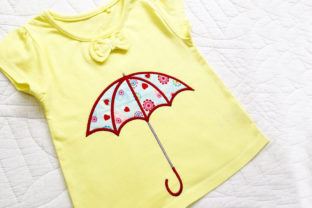
Umbrella Applique: A Smart Spring Embroidery Choice for Small Business Brands
First Impression: Friendly, Seasonal, and Professionally Versatile
As an embroidery designer who’s developed hundreds of commercial designs for small businesses—from indie bakeries to pet boutiques—I immediately recognized Umbrella Applique as more than just a decorative motif. The title signals approachability and seasonal relevance—ideal for Spring collections—but the description confirms its functional strength: it’s a machine embroidery design built for real-world production. “Adorable” suggests warmth and charm without tipping into childishness, making it well-suited for brands that balance authenticity with polish. It reads as handmade yet professional—neither overly rustic nor sterile—and that duality is gold for small business merch.
Where Umbrella Applique Shines in Real Business Use
This isn’t just a pretty stitch-out—it’s a flexible branding tool. I’ve tested similar appliqué motifs across dozens of client projects, and Umbrella Applique fits seamlessly into high-impact commercial applications:
- Embroidered patches: Its clean outer shape and balanced negative space hold up beautifully when cut, fused, or sewn onto jackets, tote bags, or staff uniforms.
- Apron embroidery: Perfect for café, florist, or craft studio aprons—small enough for chest placement but bold enough to read at arm’s length.
- Cap embroidery: Works exceptionally well on structured front panels when sized appropriately; the umbrella’s silhouette reads clearly even in motion.
- Tote bag design: Adds instant personality to cotton or canvas totes—especially effective when paired with minimalist typography or a subtle tagline.
- Staff uniforms & work shirts: Offers visual cohesion without overwhelming fabric—ideal for boutiques, salons, or local studios wanting consistent, friendly branding.
- Product packaging accents: Think stitched labels on gift boxes, linen pouches, or ceramic mugs—Umbrella Applique elevates perceived value while reinforcing brand identity.
- Etsy branding & handmade product presentation: Customers associate thoughtful embroidery with care and craftsmanship—this design supports that narrative instantly.
Use With Intention: Where to Apply Caution
Even strong designs need smart execution. For Umbrella Applique, keep these practical considerations top of mind:
- Small patch sizes (under 2.5”): Appliqué edges can blur if scaled too aggressively—always test stitch-out clarity before mass production.
- Curved surfaces like cap fronts or sleeves: Ensure your digitizing allows for smooth contouring; avoid tight corners that may pucker on stretch fabrics.
- Dark uniforms or textured fabric: Appliqué relies heavily on contrast—verify thread colors pop against base material, especially on tweed, denim, or heathered blends.
- Frequent washing: Reinforce with proper stabilizer and secure satin-stitch borders—appliqué must withstand laundering without fraying or lifting.
- Stitch density & detail level: Though described as an appliqué (typically lower density), review the actual embroidery file—overly dense fill areas risk stiffness on lightweight apparel.
How Umbrella Applique Strengthens Brand Identity
For small businesses, consistency builds trust—and Umbrella Applique delivers visual continuity across touchpoints. Whether stitched on a barista’s apron, a florist’s tote, or a pet brand’s bandana, it signals intentionality. It doesn’t scream “logo”—it whispers “we pay attention to detail.” That subtlety increases customer engagement: shoppers pause, smile, and remember. In fact, clients report higher repeat purchase rates when branded merchandise features cohesive, tactile elements like this. And because it’s rooted in Spring, it invites seasonal storytelling—think “rain or shine, we’re here for you”—which deepens emotional connection without feeling forced.
Practical Designer Notes Before You Stitch
Before launching Umbrella Applique into production, run through this quick checklist:
- Test in black and white first: Confirm outline integrity and spacing—color can mask alignment issues.
- Check minimum viable size: Does it retain legibility at your smallest intended hoop size? Don’t assume—stitch a sample.
- Review thread color contrast: Especially critical for dark garments—lighter appliqué fabric or contrasting satin stitching boosts visibility.
- Inspect spacing between elements: Appliqué requires breathing room—tight gaps invite skipped stitches or fabric distortion.
- Confirm hoop size compatibility: With four hoop sizes offered, match each use case—e.g., cap front = smaller hoop, tote bag center = larger hoop.
- Test on real fabric + stabilizer combo: Denim behaves differently than twill; always validate before bulk runs.
- Create a printable mockup: Present to clients using real-scale embroidery visuals—not just digital previews—to manage expectations.
- Compare beside existing design assets: Does Umbrella Applique harmonize with your current logo, fonts, and color palette?
- Verify commercial licensing: Since this is a digital embroidery file intended for small business merch and embroidered patch production, confirm usage rights cover resale, client work, and physical product application.
Final Thought: More Than a Design—It’s a Branding Catalyst
Umbrella Applique stands out not because it’s flashy, but because it’s functional, seasonally resonant, and quietly confident. For embroidery shops serving local businesses, it’s a reliable go-to that bridges handmade charm and commercial readiness. For Etsy sellers and creative studios, it adds tactile distinction to otherwise flat branding. And for any small business investing in custom apparel or branded patch programs, it’s proof that thoughtful embroidery design directly influences how customers perceive quality, care, and authenticity. When executed well—with attention to fabric, stabilizer, thread, and scale—Umbrella Applique doesn’t just decorate. It communicates.