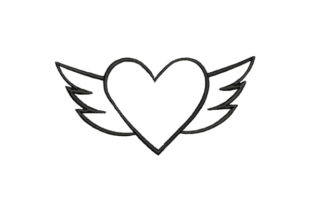
Heart with Wings Line Art
A Practical Review for Small Business Merch & Branded Patches
As an embroidery designer who’s developed hundreds of commercial designs for cafés, boutiques, bakeries, florists, and handmade brands, I approached Heart with Wings Line Art not as a holiday decoration—but as a functional brand asset. The title alone signals clarity and intention: it’s line art, so minimalism and scalability are built in; “heart with wings” evokes warmth, uplift, and gentle movement—ideal for businesses that want to express care without cliché. It feels modern, friendly, and quietly elegant—not overly romantic or juvenile, which makes it unusually versatile for Valentine S Day and year-round use.
How It Performs Across Real Small Business Applications
This machine embroidery design shines where subtlety and recognition matter most. On a café apron? It reads cleanly at 2.5" wide—balanced, uncluttered, and instantly legible from across the counter. As a chest logo on staff uniforms or a boutique’s custom apparel line, its clean outline holds shape without heavy fill stitches, reducing stitch density and production time. For embroidered patches—especially those sewn onto tote bags, denim jackets, or pet brand collars—it scales beautifully down to 1.75", retaining definition without thread crowding or distortion.
Cap embroidery benefits too: the wing lines taper naturally toward the top, avoiding awkward truncation at the crown curve. As a sleeve detail on work shirts or a minimalist mark on product packaging accents (like fabric tags or gift bag seals), Heart with Wings Line Art adds handmade charm without overwhelming the item’s function. Etsy sellers report strong engagement when using it as a signature touch on handmade product bundles—customers recognize it across listings, reinforcing brand identity without words.
Where Caution Is Needed—Design Limits & Fabric Realities
While the line art style offers flexibility, it’s not universally forgiving. On highly textured fabric—like bouclé knit caps or burlap tote bags—the fine outer strokes may blur or skip if stabilizer isn’t precisely matched. Likewise, dark uniforms demand careful thread colors: a single-tone black-on-navy execution can disappear unless you add subtle underlay or test contrast first. Avoid placing it on sharply curved surfaces (e.g., baseball cap brims) at full size—opt instead for a simplified version or reposition higher on the front panel.
Also note: because it’s line-based, tiny versions (<1.25") risk losing wing definition or heart symmetry during digitizing or stitching. Always request or create a printable mockup at your target patch size before approving production. And if your small business merch includes items that undergo frequent washing—think restaurant aprons or reusable market totes—confirm the embroidery file uses secure underlay and lock stitches at key junctions. A poorly stabilized line art design can fray faster than dense fills.
Building Trust & Value Through Thoughtful Embroidery
Heart with Wings Line Art doesn’t just decorate—it communicates. Its simplicity reads as intentional, not inexpensive. That builds customer trust: shoppers associate clean line work with craftsmanship and attention to detail, especially when paired with quality fabric and precise stitching. For local businesses, it creates visual consistency across touchpoints—same motif on staff caps, customer tote bags, and thank-you cards—strengthening recall without shouting a slogan.
More importantly, it supports a handmade product aesthetic without looking amateurish. Unlike script logos or ornate motifs, this design avoids dated trends. It works equally well for a flower shop’s spring launch, a pet rescue’s volunteer gear, or a ceramicist’s studio branding—making it a smart long-term addition to your design assets. When customers see it repeated meaningfully—not just slapped on everything—they begin to associate it with your values: kindness, lightness, authenticity.
Essential Embroidery Designer Notes Before Production
- Test in black and white first—this reveals balance, spacing, and potential gaps invisible in color previews.
- Check minimum viable size—run a 1.5" version on scrap fabric matching your final garment’s weight and texture.
- Review thread color contrast on both light and dark substrates; consider matte vs. metallic threads for tonal variation.
- Inspect spacing between wing tips and heart curves—tight areas may need manual digitizing tweaks to prevent thread nesting.
- Confirm hoop size compatibility—some versions may require larger hoops; verify before batching orders.
- Use appropriate stabilizer: cutaway for knits, tear-away for stable wovens, and fusible + tear-away for lightweight linens.
- Create a physical mockup for client approval, not just digital—fabric drape changes perception dramatically.
- Compare beside existing design assets—does it harmonize with your current logo, typography, or palette?
- Verify commercial licensing before applying to merchandise for resale—many digital embroidery file vendors restrict usage unless explicitly stated.
In short, Heart with Wings Line Art is more than a seasonal stitch—it’s a scalable, emotionally resonant element for small business merch. When treated with intention—from stabilizer choice to placement logic—it elevates apron embroidery, cap embroidery, tote bag design, and beyond. It reminds us that even simple line art, when rooted in real-world use, becomes part of a brand’s quiet confidence. And in today’s crowded marketplace, that kind of thoughtful distinction? That’s what keeps customers coming back—not just for love, but for loyalty.